

How Should You Feed Two Subwoofers From a Stereo Preamplifier?
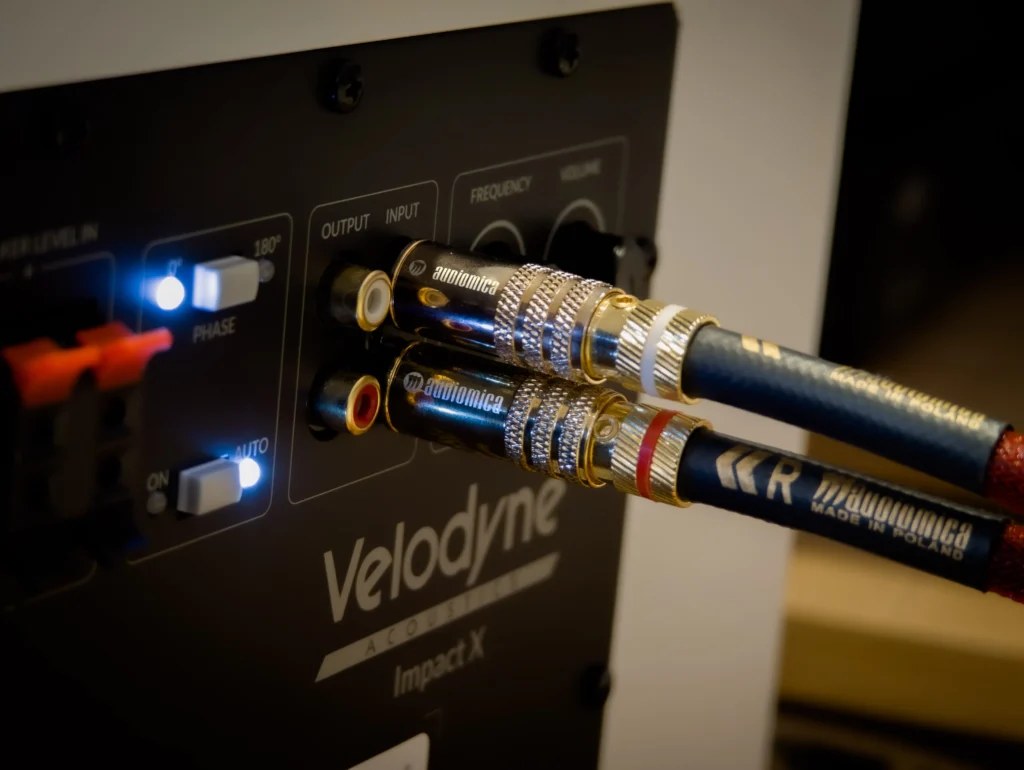
Two subwoofers tempt us to begin at the rear panel: find two sockets, buy two long interconnects, then adjust level and phase. The better starting point is the signal, not the socket count. It tells us whether the subs receive mono bass or separate channels, whether they follow the main volume control, and how much input load the output stage must drive.
Anyone trying to connect two subwoofers to stereo preamp outputs should first ask who creates and controls the bass signal. It may be the preamplifier, an external processor or the subwoofers themselves. Until that role is clear, a neat connection can still omit half the programme or place a fixed-level signal behind a moving main volume.
We therefore establish the signal identity, level control, processing, load and destination before counting cables. Once those jobs are known, the required line-level runs, connector format and length become clear. Adapters cannot turn an uncertain layout into a complete one.

Which Output Should Control Both Subwoofers?
A volume-controlled pre-out is the natural starting point because the main speakers and subwoofers need one master control. After their relative levels are set during integration, they should rise and fall together as listening volume changes. The source may be a conventional stereo pre-out, a dedicated subwoofer output or another variable line output whose specified behaviour suits the system.
A fixed record or tape output does not follow that relationship. Its level typically stays constant while the preamplifier’s main output changes, so a subwoofer can remain loud while the main speakers are turned down. Use it only when one downstream controller governs every destination together. Without that shared control, the system loses its most basic operating relationship.
Some preamplifiers provide two sets of main outputs for more than one power amplifier, or for a main amplifier and subwoofers. This is wonderfully direct when both sets are active, follow the master volume and are intended for simultaneous use. Even then, matching labels do not prove matching circuitry: the outputs may have independent buffers, share one output stage or carry a stated load limit.
Keep the electrical roles separate too. Line-level interconnects and speaker cables serve different roles, and a pre-out-to-subwoofer connection sits on the line-level side. Choose the function before the plug. RCA or XLR termination can match the interfaces carrying the signal, but an adapter cannot make a fixed output variable or add bass management.
Should Two Subwoofers Receive Mono Bass or Separate Left and Right Signals?
Stereo subwoofer routing sends the left line-level channel to the left subwoofer and the right channel to the right subwoofer, preserving the bass information carried by each channel. It suits a system in which channel identity is intentional and each subwoofer can perform the required low-pass filtering, or an upstream processor already supplies filtered left and right feeds.
Mono is equally deliberate when an upstream device combines the relevant bass from both channels and sends that result to both subwoofers. Simply using one left or right output does not achieve the same thing. One channel is not a mono sum; sending it to both subs can discard bass information carried only, or mainly, by the other channel even though both cabinets make sound.
Low-frequency directionality does not decide this on its own. Separate left and right feeds retain channel-specific content and may suit a purist two-channel system. A centralized mono-bass arrangement can coordinate filtering, delay, level and room correction in one place. Choose between channel identity and centralized control according to the actual system’s processing facilities and placement freedom.
Use the equipment that already performs the required task correctly. If a preamplifier offers variable stereo outputs but no bass management, left-to-left and right-to-right is our preferred starting point for two subs with their own filters. If a processor creates a specified mono sub feed, distribute that feed rather than asking a passive cable to create it. In either case, account for both channels and one common volume reference.
What Do Two Subwoofer Output Sockets Actually Provide?
The label dual subwoofer outputs tells us only how many sockets are present. The precise model tells us what those sockets carry: duplicated mono, separate left and right content, or independently processed feeds. The outputs may track master volume and apply upstream filtering, but none of that can be inferred from “Sub 1” and “Sub 2” printed on a rear panel.
|
Source output |
L/R/mono programme |
Volume behaviour |
|
Variable stereo pre-out pair |
Left and right remain separate |
Follows master volume |
|
One specified variable mono/sub output through a one-to-two split |
The source or processor has already created the mono programme |
Follows master volume only if specified for that output |
|
One variable stereo pre-out pair, split once per channel |
Left output remains left; right remains right |
Both channel splits follow the same master volume |
|
Two sub outputs, used only after the exact model manual defines them |
Whatever that manual states: duplicated mono, separate L/R or independent processing; never inferred from socket count |
The manual must state whether both track master volume |
|
Two simultaneously supported variable pre-out sets |
Stereo programme on each specified set |
Both sets follow master volume when specified |
|
Source output |
Filtering/summing owner |
Combined load |
|
Variable stereo pre-out pair |
Each sub filters locally, unless specified upstream processing says otherwise |
Each channel normally sees its one destination input |
|
One specified variable mono/sub output through a one-to-two split |
Upstream source/processor performs any summing; filtering may be upstream or local as specified |
One source output sees the two sub inputs in parallel |
|
One variable stereo pre-out pair, split once per channel |
Subwoofers normally low-pass locally; main-amplifier legs remain full-range unless another specified device performs high-pass filtering or bass management |
Left channel sees the left power-amplifier input in parallel with the left sub input; right is calculated separately |
|
Two sub outputs, used only after the exact model manual defines them |
The manual’s model-specific design assigns filtering, summing and per-output processing |
One input per independent output, or a shared/parallel load if the manual identifies such a stage |
|
Two simultaneously supported variable pre-out sets |
Subwoofers may filter locally; the preamplifier remains the level owner |
Loading depends on whether the sets are separately buffered or share circuitry |
|
Source output |
Destination |
Exact runs/termination |
|
Variable stereo pre-out pair |
Left pre-out to left sub; right pre-out to right sub |
Two line-level runs; RCA or XLR as fitted at both ends |
|
One specified variable mono/sub output through a one-to-two split |
The same mono feed reaches both subs |
One output divided into two same-format line-level terminations |
|
One variable stereo pre-out pair, split once per channel |
Each output feeds its matching power-amplifier and subwoofer inputs |
Two independent Y branches with four destination legs, never an L/R tie |
|
Two sub outputs, used only after the exact model manual defines them |
Sub 1 and Sub 2 according to the specified assignment |
Normally two runs, with format and channel labels taken from the exact implementation |
|
Two simultaneously supported variable pre-out sets |
One set to the main amplifier, one set to the subwoofers |
Main-amplifier runs plus two sub runs in their native formats |
Rear-panel photographs cannot show the electrical difference exposed by the table. A stereo pair shared with the power amplifier creates two separate load calculations and four destination legs. An already-summed mono feed creates one source load with two subwoofer inputs in parallel. Both arrangements may use Y hardware, but they are different systems.
Treat two sub sockets with the same care. The exact manual must identify the programme on each output, whether both follow master volume, where filtering and summing occur, and whether the outputs are independently driven or share a load condition. Until it does, “dual” is a socket count, not a signal description.
When Can One Output Feed Two Inputs Without Overloading the Source?
A parallel input load occurs whenever one output stage drives two subwoofer inputs. The source sees their electrical combination, not either published input impedance by itself. For two input resistances, the relationship is 1/Rtotal = 1/R1 + 1/R2. Two 20 kΩ inputs therefore present 10 kΩ in parallel; a 20 kΩ and 50 kΩ pair presents about 14.3 kΩ.
Test one source channel at a time. Compare the calculated total input impedance with the minimum permissible load stated for that exact output mode in the same unit—normally kΩ. The branch passes only when the documentation explicitly supports it or the calculated total meets or exceeds that stated minimum. Output impedance is not a minimum-load figure. If load capability is omitted, the result remains unresolved rather than supporting a universal ratio; ask the manufacturer to confirm the branch or use buffered distribution.
Separately buffered outputs can remove the parallel-input demand from one source stage, while two sockets connected to shared circuitry may not. A supported stereo pair feeding one input per channel will usually require each channel to drive only its own subwoofer input. The circuit boundary decides where the loading falls, so establish the specified output arrangement before ordering a splitter or second cable.
Longer runs do not change the resistance formula for the two sub inputs, but they add a practical reason to make the source-to-destination connection deliberate. Cable capacitance, screening, connector contact and the surrounding routing environment remain part of a real line-level interface. Once the output operates inside its intended load, a well-chosen interconnect supports a stable, repeatable installation rather than trying to rescue an unsuitable source stage.

When Is a Y Splitter Correct, and When Is It an Unsafe Summer?
A subwoofer Y splitter is correct when it sends one supported output to two compatible inputs. Both destinations receive the same signal, already defined upstream, while the source drives their combined parallel load. This is the valid one-to-many use: a volume-controlled mono or sub feed can serve two subwoofers if its output stage supports the demand.
There is another legitimate one-to-many arrangement when a stereo preamplifier has only one variable output pair and the power amplifier already uses it. Fit two independent one-to-two fan-outs: left pre-out to the left power-amplifier and subwoofer inputs, then right pre-out to the corresponding right-side inputs. The branches never cross channels or combine left with right.
Calculate the two channels as separate electrical jobs. The left preamplifier channel drives its power-amplifier input in parallel with the left subwoofer input; the right channel faces the matching relationship. Each fan-out passes only when its unit-matched total meets or exceeds the documented minimum load, or the exact arrangement is explicitly supported. Output impedance is not that minimum. If load capability is absent, the branch stays unresolved, so ask the manufacturer to confirm it or use buffered distribution. Once both channels pass, stereo identity remains intact and the main amplifier and active subs continue to follow the master volume.
Filtering stays wherever the equipment puts it. In this arrangement, the main-amplifier legs normally remain full-range while each subwoofer applies its own low-pass filter. That is suitable for a conventional two-channel addition, but it does not create high-passed main speakers, time alignment or centralized bass management when the system needs those functions.
If either channel presents an unsupported load, or if centralized functions form part of the design, choose different hardware. Separately buffered outputs, supported active distribution, or a suitable crossover or processor can take responsibility, provided the specified behaviour preserves channel identity and keeps every destination under the intended master-volume control.
Reverse the fitting and its electrical role changes. Passively tying left and right outputs together can make two active output stages drive one another, with the result governed by their internal impedances rather than by a controlled summing circuit. A splitter distributes; it does not engineer a sum. Its physical symmetry should never hide that electrical asymmetry.
To make mono bass from stereo programme material, use a device designed to combine it: specified bass management, a suitable processor or a proper summing network with the required isolation. This preserves both channels and gives their combination to a known circuit. You should be able to name the summing device, because it also determines whether the result is full-band mono or low-pass-filtered bass and where level or delay adjustment occurs.
The dividing line is simple. A Y connection is wrong when it joins two source outputs, when the single source cannot support the parallel inputs, or when it distributes a channel that was never the intended programme. A valid fan-out has one source signal, two destination inputs and an acceptable combined load, whether that source is mono or one channel of a stereo pair.
Does a Subwoofer Output Pass Through, Filter, or Create a True Daisy Chain?
A subwoofer daisy chain exists only when the first subwoofer provides an output suitable for the second. The printed output function matters more than the connector shape. That output may be a direct or buffered pass-through, a high-pass feed for main speakers, a low-pass or processed output, or one whose level behaviour follows the first subwoofer’s controls.
In a distributed arrangement, the preamplifier may send full-band left and right signals to two subwoofers, with each applying its own low-pass filter. A pass-through can carry an exact or buffered copy onward if the design specifies that behaviour. Each subwoofer still owns its integration duties, including crossover, phase, level and any channel-specific behaviour.
Centralized bass management moves those duties upstream. A processor may form mono or retain stereo, apply low-pass and sometimes high-pass filtering, then send purpose-defined outputs to the subwoofers and main channels. The downstream cable carries what the processor has created; another cable branch cannot add a missing filter, sum, delay or routing function.
Treat the subwoofer output as a fresh source rather than a transparent extension by default. A specified full-range pass-through may reduce cable distance or the number of home runs. A filtered output, or one governed differently, makes that behaviour part of the system. At every control setting—including when controls on the first sub change—the second sub’s signal should remain understandable.
When Is a RHOD Pair the Right Final Link?
A paired RCA interconnect is our natural recommendation when variable left and right RCA feeds require two equal-purpose line-level runs from the preamplifier to the subwoofers. In that arrangement, RHOD gives both channels consistent construction and one selected length as a single stereo solution.
Our RHOD Reference analog interconnect is available with RCA and XLR connector options. We supply the base 1 m RCA Standard configuration as a pair. Selectable lengths run from 1 to 5 metres in half-metre steps, and custom lengths can also be ordered. Paired supply and flexible length choice suit a two-subwoofer installation, where both runs often extend beyond the equipment rack and should not become two unrelated purchases.
RHOD Reference uses OFC 6N conductors, a copper-braid screen, 2 × 0.81 mm wire corresponding to 2 × 0.51 mm² cross-section, and an approximate 8.5 mm overall diameter. We hand-terminate it with the specified connectors; the RCA version uses a split pin and screw casing, while available options include antistatic couplers and the DFSS Premium or TFSS Luxury variants. Through their screening, construction and termination, both runs receive the same deliberate physical execution. That consistency does not pretend that a cable can correct the wrong signal arrangement.
We think RHOD deserves comparison when a resolving stereo system already provides variable left and right RCA feeds that can drive the intended input loads, and subwoofer placement calls for a properly specified pair rather than two convenient leads that merely reach. Its positive appeal is paired supply, useful length choice and consistent execution across both runs. If that describes your system, choose the pair and length that suit it, then make the final judgment in your own listening room.


