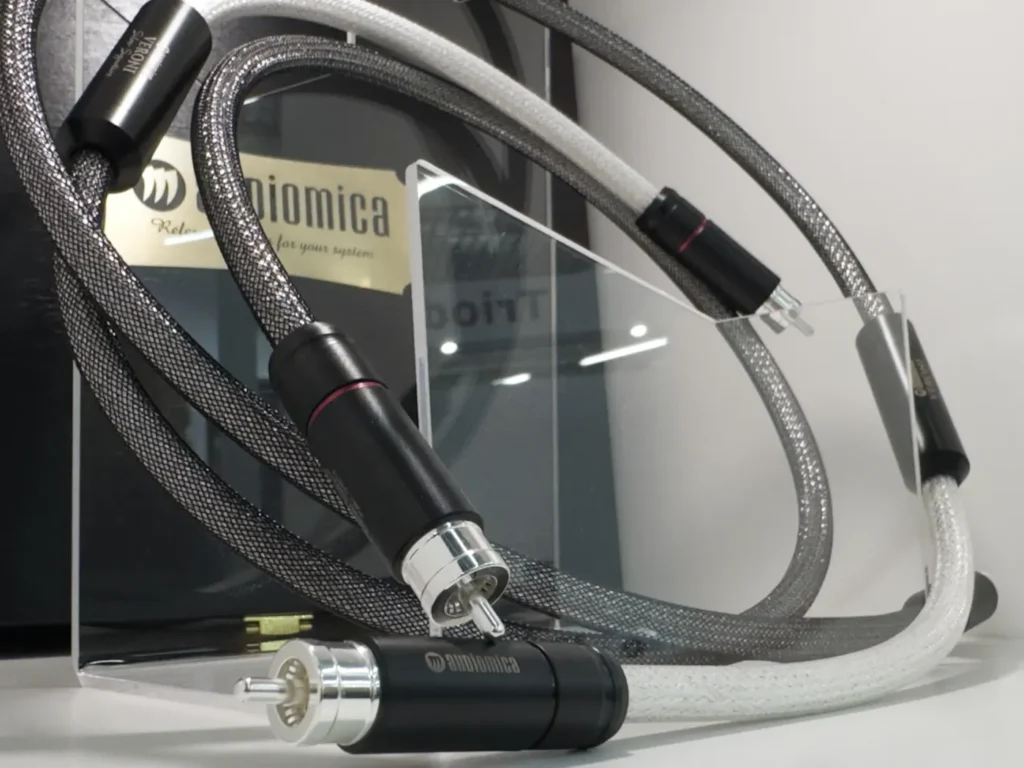
The tonearm cable connection choice can look like a contest between a sophisticated removable part and a simpler fixed one. It is not. Detachability tells you what you can change; by itself, it says nothing about how good the tonearm sounds.
The useful question is whether the arm, lead, phono stage and earth connection work together as the equipment was designed to work—and whether they do so quietly and comfortably in your room. Serious analogue equipment takes both approaches. Some tonearms integrate the external phono lead into the arm assembly, while others provide a five-pin output specifically for a cable chosen by the owner. What changes is the point where ordinary owner access ends. In a captive design, that point lies inside the complete arm-and-lead assembly. In a detachable design, it is the socket made for a separate cable. Neither arrangement carries an automatic musical advantage.
The difference starts to matter when the system changes. A captive lead removes one owner-accessible plug-and-socket junction, but its length and plugs stay fixed unless the assembly is serviced. A detachable output adds that junction while giving you control over length, termination and construction for a new rack position or phono stage. That flexibility earns its value when the installation has a real use for it.
Most systems lead to one of three sensible choices. Keep a fitted lead when it is quiet, undamaged, long enough and correctly arranged for the phono stage. Choose an external lead when the tonearm already has a detachable output and you want control over length, placement or construction. If a captive arrangement no longer serves the system, take the arm to a qualified specialist.
When Is a Captive Phono Lead the Stronger Choice?
A captive phono lead is often the stronger choice when the tonearm was conceived as a complete assembly and the fitted cable reaches the phono stage without strain or awkward placement. In that setting, integration can be evidence of design discipline rather than a limitation.
There is no second owner-accessible junction at the arm base, no separate connector body to fit beneath the plinth and no uncertainty about the external termination the manufacturer intended. The RB880 makes this approach easy to see: Rega describes a bespoke external phono cable fitted to the arm, with a two-part plug assembly intended to minimise joints. This is a virtue of that particular implementation, not a verdict on every detachable connector. It shows why a serious designer may prefer fewer accessible connections when cable substitution brings little practical benefit.
A well-installed fixed lead also settles the matter cleanly. When it follows an uncluttered line to the phono stage, reaches without tension and stays free from intermittent contact, you can put your attention back on cartridge alignment, record condition and music. That suits the listener who values a stable turntable more than the opportunity to revisit the connection.
The compromise appears when the system moves on. New furniture may expose the limitation of the fixed length, different electronics may make the plugs inconvenient, or damage may require work on the arm assembly. Rega warns that unauthorised modification of the RB880 may invalidate warranty cover and directs service enquiries through its dealer network. Choose this kind of arm with the understanding that future cable work may properly belong on a service bench.
When Does a Detachable Tonearm Cable Earn Its Flexibility?
A detachable tonearm cable earns its flexibility when the tonearm provides the socket by design and the system gives that access a purpose. A shorter lead can remove an unnecessary loop behind the rack, while a longer one can let the phono stage sit in the sensible position. A different compatible termination can follow a change of electronics without disturbing the wiring inside the arm. Length and placement remain open to refinement as the system evolves.
Serviceability is the immediate benefit, and it is useful before anything fails. You can remove the external lead for transport, inspect its accessible contacts and replace it without opening the tonearm. In return, you accept one more plug-and-socket connection. The plug must seat fully, the socket needs enough room around it, and the cable should not hang from the arm base with its weight concentrated in a sharp bend. Our guide to maintaining accessible audio connectors applies at precisely this reachable point: inspect the removable plug, reconnect it securely and leave damaged internal contacts to a technician. Routine care stays outside the arm, where the design places it.
Once the contacts are clean and secure, room around the connector and proper support for the cable keep that convenience dependable.
After the essentials are right, detachability offers a more interesting reward. In a quiet system with compatible endpoints and an established earth connection, enthusiasts can compare complete cables through their construction, handling, terminations and behaviour in the system. Correct operation is the foundation for that considered refinement, and the detachable output keeps the comparison outside the arm.
The case changes completely if gaining detachability means modifying a captive arm. Adding a socket moves the boundary of service access, changes the physical loading at the arm base and replaces the original connection scheme. An available adapter or a suitable-looking socket does not turn that work into an ordinary accessory change.
How Should Grounding, Routing and Connector Access Shape the Decision?
The phono grounding scheme belongs in the decision from the start. Treat the earth connection specified for the equipment as part of the same task as the signal plugs, not as a loose wire to remember at the end.
Some turntables or tonearms use a separate signal-earth lead for the earth terminal on the phono stage; others arrange grounding differently. Connector shape alone cannot tell you what the system needs. The Rega Fono MM manual provides a precise example: when the turntable or arm has a separate signal-earth connection, the lead goes to the stage’s earth terminal. Before selecting an external cable, consider the tonearm output, phono-stage input and earth as one connection. Signal endpoints and grounding must agree before conductor material, brand or price becomes interesting.
Now look at the space the cable must occupy. A downward-facing five-pin socket may sit close to a shelf. A substantial connector body may need more clearance than the plinth allows, while a stiff bend immediately below the tonearm can put leverage on the socket. Tightly spaced RCA inputs can cause the same difficulty at the phono stage. Measure the path a terminated cable can actually follow, with room for relaxed bends and fully seated plugs.
Placement matters because the cartridge sends a low-level signal. The right length belongs to the whole installation, not merely to the distance between two sockets.
Power supplies, mains cables and tightly packed electronics can make the shortest route the least sensible, so equipment-specific placement instructions deserve attention. Use enough cable to avoid interference sources where possible, without leaving a large coil beside power hardware. Electrical compatibility may also influence length when the cartridge guidance specifies a total capacitive load. The internal arm wiring, external lead and phono-stage input then contribute to one system capacitance seen by the cartridge. The lead’s share can change with cable construction and length, an issue encountered most often with moving-magnet cartridges. Where the loading window matters, use published component and cable data or manufacturer guidance. If a value is unavailable, leave it unknown rather than guessing.
With all of that visible, the practical decision becomes simpler. Start with the designed tonearm output and phono-stage input, including any separate earth. Leave room around both connectors, then choose a cable path that meets the physical and electrical requirements. If those conditions conflict, move the equipment or reconsider the cable before altering the arm.

When Should You Replace a Fixed Turntable Cable?
A fixed turntable cable replacement makes sense when a real service or installation problem matters more than preserving the original assembly. Let the specific fault or limitation define both the work and the result you expect.
An intermittent channel, physical damage, a connector that no longer makes reliable contact or a length that cannot support the necessary placement all give you substantial reasons to act. Repair and conversion solve different problems. Repair restores the intended arrangement. Conversion creates an owner-accessible connection and may require work inside the tonearm or plinth. Strain relief, connector mounting, wiring continuity and future servicing become part of the job. Once the arm assembly is open, this is tonearm service, even if the only visible change is a new socket.
Let manufacturer guidance lead that work. A documented replacement procedure or an approved service channel gives a technician a known basis for repair, and warranty terms may restrict unauthorised changes. For an arm without an owner-serviceable cable connection, a qualified specialist can judge whether repair, a replacement assembly or a carefully justified modification is appropriate. A worthwhile change respects both the arm’s construction and its future reliability.
A wider choice of cables is not, on its own, a persuasive reason to convert an intact fitted design. Keep the present lead when it is quiet and suitable. When it is faulty or genuinely incompatible with the installation, take that concrete problem to a qualified service specialist.
When Does THASSO Consequence Fit the Detachable Route?
THASSO Consequence is our tonearm-to-phono cable for an arm that already has a compatible external output—one whose designer made the connection detachable.
We make it in two versions: RCA to RCA with WBT 0102 Ag nextgen plugs, and RCA to five-pin DIN with gold-plated 5DIN hardware. Those names identify the connector families we offer; they do not prove how a particular five-pin tonearm output mates. Before ordering the RCA-to-five-pin version, match the arm’s actual five-pin implementation, including plug-or-socket orientation and pin arrangement, to the selected build. Then confirm the phono-stage RCA inputs and the equipment’s documented separate-earth scheme. Lengths run from 1 metre to 5 metres in half-metre steps, with an other-length request and a customised-order route also available. This range matters when the phono stage cannot sit beside the turntable or when the clean physical path is longer than the furniture’s direct line. Order for the installation you have; the “RCA-5DIN” label is not a completed compatibility check.
THASSO uses 6N OCC copper conductors and has an approximate overall diameter of 12.5 mm. Depending on the version, those conductors meet WBT RCA plugs or gold-plated five-pin termination in the finished cable. Conductor construction, termination quality and physical handling deserve to be considered together when refining this accessible part of a vinyl system.
We hand-make THASSO and supply it in a signed wooden box with a certificate carrying the cable name, product code and personal quality assurance. Traceable individual assembly is part of what its owner receives.
This is intended as a long-term component for a point in the system that the tonearm designer deliberately left open to selection. Compare it with familiar records while keeping level and setup conditions steady. Listen for instrumental colour, image stability, the shape of low-level decay and the intelligibility of dense passages. A controlled comparison gives the complete construction room to speak while the cartridge, arm and phono stage continue to shape the result.
First match the chosen version to the tonearm’s actual five-pin mating implementation where applicable, the phono-stage inputs and the documented separate-earth scheme. Then make sure its length suits both loading needs and physical placement. With those checks complete, high-purity conductor construction, serious termination hardware, hand assembly and personal quality assurance are concrete reasons to compare it as a premium, length-configured connection in an already accomplished vinyl setup. Explore our THASSO Consequence tonearm cable.