
Should You Keep Your Existing Cables After an Amplifier Upgrade?
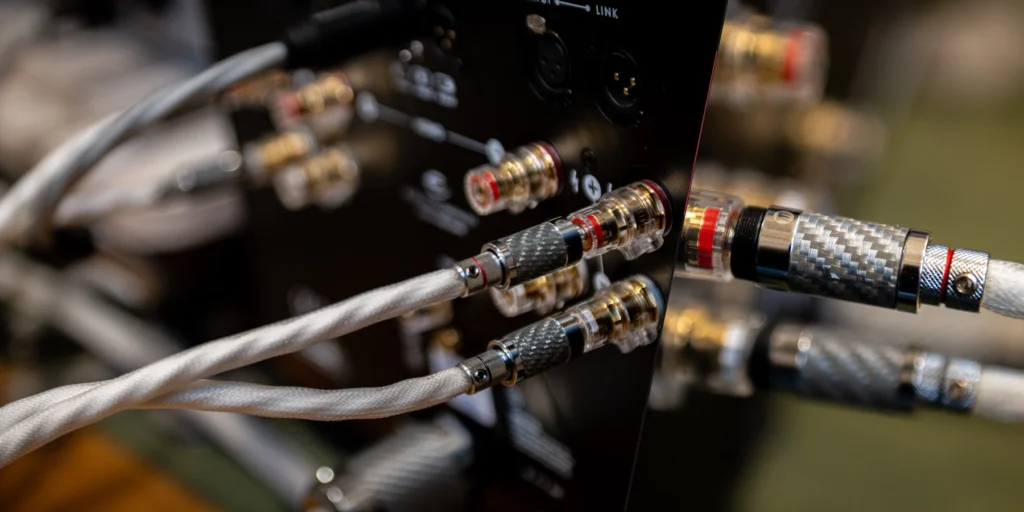
A new amplifier may leave your familiar cables entirely worth keeping. We would preserve what still suits the connection and make each further change for a reason you can name. An existing cable may remain the right choice, benefit from different termination or be unsuitable for the new installation. The amplifier's price cannot tell you which of those applies.
There is pleasure, and purpose, in getting these details right. Consider construction, termination and the way a cable sits behind the system together. Once the connection is sound, you can turn to refinement: perhaps easier handling, a more satisfying complete assembly or a listening preference that holds its appeal with the new amplifier. Keeping a good cable and choosing a new one can both be deliberate acts of system building.
What Actually Changes When You Replace the Amplifier?
An amplifier replacement calls for a close look at the connections you will actually use. Your source and speakers may stay exactly where they are, yet the new amplifier can bring different sockets, input requirements, supported speaker connections and terminal positions. Read its instructions for the operating mode you intend to use. They tell you what each cable must connect and how; consider both ends together.
A familiar assembly has already proved useful in its former setting, but the new amplifier may have different cable requirements. Even amplifiers from one manufacturer can differ. Naim's amplifier reference manual, issue 5, distinguishes amplifiers restricted to particular loudspeaker cables from models that permit other high-quality cables. This historical manual applies to the models it covers; a later Naim amplifier needs its own model-specific advice.
Establish the supported electrical connection first, then look at the plugs, termination and space available for the cable. A plug that fits is only part of a suitable connection. Listening preference cannot answer an unidentified electrical requirement, but once those practical questions are resolved, you have a worthwhile comparison ahead of you. Keeping the questions separate helps you recognise what a proposed change will accomplish.
If your existing cables meet the new requirements, we favour keeping them initially where practical. They give you a familiar reference while the amplifier is the major change, even if you already intend to compare cables later. You can then decide what you want the next purchase to contribute. If a requirement remains unclear, get advice for the particular amplifier before reusing the cable. Its value and years of dependable service make it worth considering carefully; neither can establish whether it meets a new requirement.
Can Your Speaker Cables Stay With the New Amplifier?
The new amplifier's speaker cable requirements govern construction, length and supported termination, as well as whether the cable reaches the speakers. Naim's issue 5 manual, for example, specifies a minimum of 3.5 metres per channel in its general loudspeaker connection guidance. That minimum belongs to the manual's scope. For another amplifier, use that model's requirements rather than lengthening cables simply to follow this example.
Before shortening a cable to tidy the installation, check whether the spare length is length the amplifier requires. This matters when the new amplifier sits closer to the speakers. Allow for any length that retermination would remove, too. A shorter distance between components may call for a different arrangement behind the system while keeping the cable within the lengths the manufacturer permits or specifies.
Before buying a cable for a conspicuous new output socket, look at the other supported connections. The Benchmark AHB2 has SpeakON outputs alongside binding posts intended to accommodate existing speaker cables. Here, another supported connection may let you keep the assembly you know. Read the available connections before buying around the most prominent socket on the rear panel. Consider a manufacturer's preferred connection alongside any alternatives it explicitly supports.
Check the operating mode as well as the socket. The AHB2 specifies different speaker connections for stereo and bridged-mono use, so a familiar socket can require a different channel assignment. If you are changing operating mode as well as amplifier, follow the connection instructions for that mode. Successfully inserting a plug tells you nothing about whether the required conductors have been assigned correctly.
Keep the speaker cables when their construction, usable length, termination and conductor assignment suit the amplifier in the intended mode. If the connector is the only mismatch, retermination may preserve a worthwhile assembly. Replacement becomes necessary when suitability cannot be established or achieved; setup adjustments and listening cannot compensate for that unresolved requirement. Examine the connection when the amplifier changes, while giving the cable every reason to keep its place if it remains suitable.
When Is Retermination Better Than Replacing the Cable?
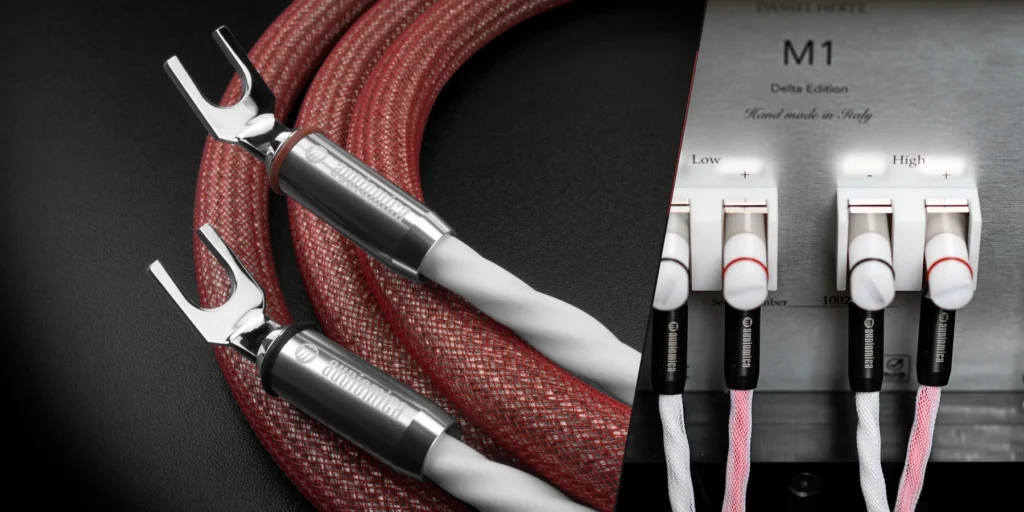
Cable retermination is worth considering when only the supported connector needs to change. A sound cable can remain a valuable part of the system with a different end fitting. Its construction, conductor assignment, connector support and finished length must all remain appropriate. Judge the resulting connection as a whole, beyond the appearance of the new plug.
Put the new amplifier in its intended position before judging how much cable you have to spare. Usable reach can be shorter than nominal cable length: a deeper chassis, wider terminal spacing or a connector that projects farther backwards can use up slack. The cable needs to leave the plug naturally, with room for you to insert and release it. Look for sideways pull or unsupported weight at the connection before paying for new terminations.
Imagine that your familiar pair reaches the new terminals only when pulled taut behind the rack. Losing a little more length during retermination would make matters worse. A different supported cable arrangement, moving the equipment where practical or buying a suitable length may serve the system better. We would reject an adaptation that leaves the cable strained or inaccessible, however valuable the original assembly. Retaining the conductor is worthwhile when you end up with a good connection.
Condition matters too. Follow the equipment's power-down instructions before disconnecting anything, then look at accessible cable ends and housings for damage or a poor fit. Our guide to inspecting accessible plugs and terminals offers further help. The equipment's own care instructions take precedence, including any restrictions on cleaning products. A new plug cannot repair damage elsewhere in the cable; equally, an unfamiliar contact problem deserves investigation before you discard the entire assembly.
A competent cable specialist can assess both the proposed work and the finished connection. Discuss the amplifier and speaker terminal details, cable construction, required final length and how the assembly can be serviced later. Retermination trades some original flexibility for a new connection: workmanship, lost length and future use all matter. If the new system needs a different circuit role or cable construction, replacing the plug alone will not provide it. A suitable new assembly is then the clearer choice.
Do Different Inputs Require Different Interconnects?
Existing analogue interconnects can stay when both the source output and amplifier input support the complete connection. Your source may retain its familiar output while the new amplifier presents a different input type, sensitivity or impedance. RCA and XLR identify part of what you are connecting. The equipment specifications tell you how the interfaces at the two ends are intended to work together.
Take an unbalanced source feeding a balanced input. Both pieces of equipment determine how the connection should be wired. The AHB2 manual specifies adapter cables for that situation, while Rane's interconnection guidance distinguishes arrangements according to the output and input implementation. An adapter's appearance cannot establish whether its wiring is appropriate, and putting an XLR connector on an unbalanced source does not make that source balanced.
An adapter arrangement specified for the equipment may offer a sensible way to retain an existing cable. Look at how the cable and adapter sit together behind the amplifier. An awkward rigid extension, strain on a socket or uncertainty about the actual wiring can make a purpose-made assembly for the required interface more attractive. Have the connection checked for the equipment involved instead of assuming a universal RCA-to-XLR wiring rule.
A source can be poorly matched to an input even when the plug fits. Check input impedance and sensitivity, which describe different relationships with the source. Impedance is the load the input presents; sensitivity concerns the signal level needed to obtain a specified amplifier output. Neither follows from connector fit. If the source's output capabilities do not suit the new input, changing the interconnect without addressing that mismatch leaves the cause in place.
If you retain an unbuffered resistive passive volume control, assess the control, cable and new amplifier input together. In this arrangement, cable construction and installed length can affect frequency response. The control's effective output impedance varies with its setting and interacts with the interconnect's capacitance and the amplifier's input load. The extent of any effect depends on that combination; an audible change is not established for every system. Other passive preamplifier designs need their own assessment.
A different amplifier sensitivity may also move the passive control's usual setting, changing the conditions of the connection. A familiar interconnect can face a new matching problem without deteriorating. Compare the passive unit's intended load and cable conditions with the new amplifier and the installed cable before deciding what to keep. If the combination remains suitable, keep the cable as your starting point. If something needs to change, identify which part rather than automatically putting the cable at fault.
Could Gain Explain What You Hear After the Change?
Check input sensitivity when the volume control starts behaving differently after the amplifier change. The same control position need not give the same listening level. A new amplifier may need a different signal level to reach a given output, and some models offer a sensitivity or gain setting for different sources. The appropriate setting depends on the source and amplifier now working together.
Gain selection can alter what you hear with the same cable in place. The AHB2 manual describes the trade-off: too little sensitivity can prevent the source from driving the amplifier to rated output, while too much amplifies source noise unnecessarily. This adjustment is model-specific. Where your amplifier offers it, establish how to use it correctly before judging a cable by noise, listening level or volume-control position.
Suppose the new system seems noisier, or reaches familiar loudness much earlier on the control. Check setup and source matching first; those observations alone do not identify the old cable as the cause. A higher control position does not necessarily mean that the interconnect is restricting the system either. You need a comparison at an equivalent listening level, with the new amplifier configured as intended. Resolve a setup issue before treating it as a reason for a refinement purchase.
Then bring the familiar cable back into the comparison. Keep the source output setting and amplifier configuration consistent, returning to an equivalent listening level when a connection arrangement changes. Changing the interface also changes the comparison. If you move from one input arrangement to another while changing the cable, you introduce another difference. The preference you hear may concern the combination rather than the cable alone.
When Is a Fresh Cable Comparison Worthwhile?
A cable comparison becomes interesting when you know what you would like to improve in a correctly configured system. Perhaps you want a more satisfying connector arrangement, better handling in the available space, a complete construction better suited to the installation or a listening preference you can explore. An amplifier change can bring those priorities into focus while leaving every existing cable usable.
Choose assemblies that satisfy the same underlying connection requirements, then give each one equal care. Keep amplifier mode, source and loudspeaker positions stable, compare at equivalent listening levels, and attend to the placement and connection of each cable. An installation advantage can tilt the comparison. A neatly supported cable and one pulled against a shelf are being used under different conditions, whatever their labels say.
Practical benefits can be satisfying in their own right. Easier secure connection, a useful length or flexibility that makes the rack easier to manage are things you can identify directly. A handling advantage and a listening preference are distinct kinds of value; the first cannot prove the second. To explore the listening preference, return to familiar music and the previous connection, and consider whether it remains useful over repeated comparisons. A first listening impression is no guarantee of improvement.
We see a positive place here for deliberate high-end system building. You may want a carefully specified complete assembly even though your old connection already works; you may also find that the existing assembly continues to justify its place after a substantial electronics upgrade. Compatibility gives you a sound beginning for that choice. Then weigh what the alternative contributes in your installation against its cost and the introduction of another changed variable.
Keep the familiar cable while it remains suitable and valuable. Adapt it when a confirmed termination mismatch can be resolved without compromising the finished assembly, and replace it when requirements, condition or its position in the system make it unsuitable. Beyond that, pursue comparisons with a clear purpose for the change. Preserve the value already in your system, with room for thoughtful refinement as the system develops.