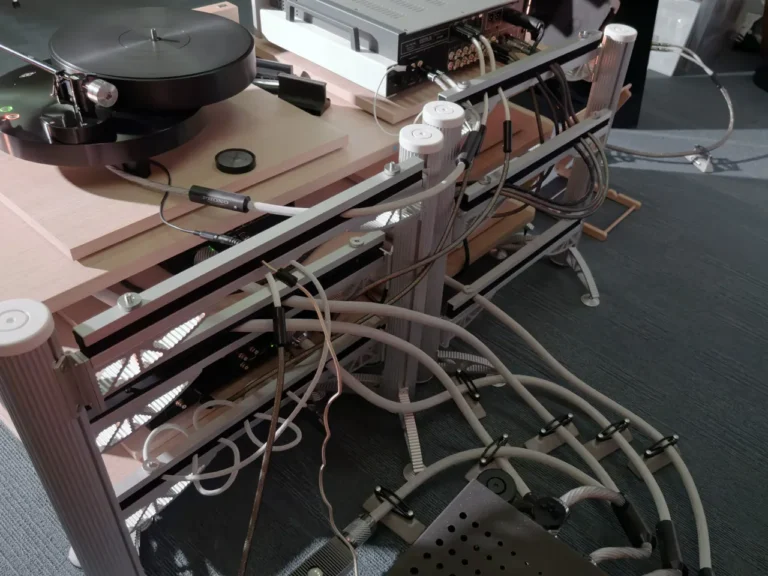

How Do You Add Home Theater Bypass Without Compromising a Stereo System?

A home theater bypass setup is attractive for one simple reason: the cinema system can borrow the established left and right loudspeakers without making the AV receiver compulsory for music. The cabling matters, but control decides whether the arrangement is safe and usable. Cinema and stereo sources need different volume owners, while the stereo amplifier and front speakers keep their familiar relationship. Success is a clean transfer of control, not merely sound from every channel.
So our first question is not whether the components have spare sockets. It is whether the two systems can follow one documented, repeatable arrangement with one volume control in charge at a time. If using the system depends on remembering two knob positions, the integration remains fragile.
There is a useful order to the work. First establish the required outputs and fixed behaviour; then assign volume control, choose the least ambiguous method, settle the bass and speaker connections, and calibrate the final system. Both operating modes should now be simple enough to describe. Only then does the permanent amplifier-to-front-speaker connection become a meaningful product choice.
What Must a Home Theater Bypass Input Actually Provide?

A home theater bypass input must provide a documented transfer of control, not just accept an analogue signal. The AV receiver or processor needs front-left and front-right pre-outs, or equivalent documented processor outputs, to send line-level signals into the stereo amplification. The stereo preamplifier or integrated amplifier also needs an input whose level can be fixed or bypassed exactly as its manual describes. If either end of that chain is missing, the bypass-through-stereo-component method ends there. A separately documented processor-to-power-amplifier arrangement may still preserve the shared front-speaker pair.
The label beside the socket is not enough. Its behaviour is what matters. Some components provide a dedicated home-theater-bypass mode; others let a specified input operate at a fixed level. In both cases, the stereo component stops acting as the normal variable volume control for that cinema input. The exact implementation is product-specific: one manufacturer may call it unity gain, another may define a fixed setting, and another may offer an adjustable bypass level. “AUX” or “XLR” alone tells us nothing about how gain is handled.
A fixed input comes with one hard safety condition: a functioning device upstream must control the signal level. Connect a source without usable volume control and the stereo amplifier may receive a very high signal, creating a real risk of loudspeaker damage. Power off the relevant components before making or changing connections, and begin first commissioning at a low, known AV volume. Do not test a fixed path at normal listening level until you are certain which upstream control owns volume.
Connector shapes are only the beginning. Balanced and unbalanced connections use different signal and grounding arrangements, so a mixed-interface connection needs manufacturer approval or competent professional advice. A short domestic RCA connection can be entirely suitable. Improvised adapters, modified shields, lifted grounds and defeated protective earth are unacceptable remedies. Reject an arrangement if its output and input cannot be joined safely and predictably.
Before buying or configuring anything, answer these five questions clearly:
- Are the front-channel outputs present? The AV unit must have front L/R pre-outs or equivalent outputs for the intended speaker assignment.
- Is the fixed behaviour documented? The stereo component’s manual must describe a dedicated bypass or a supported fixed-volume input.
- Who owns cinema volume? The AV receiver or processor must still be able to reduce level before the signal reaches the fixed stereo path.
- Do the line interfaces match? The chosen output and input must be compatible without improvised wiring or safety modifications.
- Is the state obvious? Input selection, fixed state and power state must be recognisable and repeatable in normal use.
When all five answers are secure, the components can be integrated. The remaining choice is how completely the method removes the stereo volume control from cinema operation.
Who Owns Volume After the Gain Handoff?
The gain handoff gives the AV receiver or processor sole control of cinema volume while the stereo component passes the selected cinema input at its documented fixed level. Select a normal music source and volume control returns to the stereo component. In either mode, the question “Which volume knob matters now?” should have one honest answer.
That single answer prevents double attenuation and accidental gain changes. With two active volume controls, calibration belongs to one particular combination of settings. Move either control and the front channels shift relative to the centre, surrounds and subwoofer. A remembered stereo position becomes more dangerous if the other control is already higher than expected. Calibration and household memory cannot reliably manage that hidden state.
We describe the system in two simple operating states:
- Cinema mode: select the documented fixed or bypass input on the stereo component, power the required stereo amplification, and adjust volume only at the AV receiver or processor.
- Music mode: select the desired stereo source, return the component to normal variable-volume operation, and adjust volume only at the stereo preamplifier or integrated amplifier.
An ordinary variable input set to a marked or remembered position can reproduce the same gain on a careful setup day, but it is still a workaround. It may be tolerable for a temporary experiment run by one informed user who checks the position every time. It is a poor permanent default in a shared household, with a control system that cannot read the knob position, or in any routine where the wrong state could cause a level jump. A genuine handoff is repeatable; a lucky match is not.
Which AV Receiver With Stereo Amplifier Method Should You Choose?
When combining an AV receiver with stereo amplifier hardware, choose the least ambiguous method explicitly supported by both manufacturers. The order below ranks clarity and repeatability; sound quality remains a separate question. We prefer the method that removes as much hidden state as the equipment allows.
- Prefer a dedicated bypass. Use it when the AV unit has suitable front pre-outs and the stereo component documents a dedicated bypass mode for the intended input. The AV device controls cinema volume, the stereo volume control leaves that mode, and nobody has to remember a knob position.
- Accept a documented fixed-volume input. Choose this when the stereo manufacturer explicitly supports assigning a fixed level to an input and the upstream AV device remains the sole cinema volume owner. Follow the manuals for the permitted level, setup sequence and any bypass-level adjustment. Do not assume that every fixed input means 0 dB or unity gain.
- Keep a variable input temporary. Use a reference position only when there is no fixed path, one informed operator controls the system, and the setting is checked before every use. A compromise calibrated this way should never be presented as a permanent family-safe solution.
- Keep the systems separate when the bypass route fails. Do not use the bypass-through-stereo-component method if the AV device lacks the required pre-outs, the stereo device lacks documented fixed behaviour, the interfaces cannot be matched safely, or the everyday state cannot be made obvious. Separate front speakers or a different AV component may be cleaner. A processor feeding a suitable power amplifier can still be a shared-front alternative when both manuals support the routing.
In the bypass-through-stereo-component method, the front pre-outs carry the left and right line-level signals. The stereo amplifier remains the only speaker-level source connected to the shared front loudspeakers. Check the AV manual for any amp assignment, preamplifier mode or per-channel routing needed when those pre-outs feed external amplification. Never leave the AV unit’s front speaker outputs connected to the same loudspeaker path as the stereo amplifier. The front pair must have one unambiguous speaker-level owner.
A direct connection from a processor to a suitable power amplifier can also preserve one shared front-speaker pair without sending cinema through the stereo component’s fixed input. When both manuals support it, the power amplifier remains the sole speaker-level owner, but stereo sources may need another route to that amplifier and input switching may change. This is a valid shared-front topology with a trade-off: it can give up some stereo independence or familiarity. Completely separate systems preserve independent operation but surrender the shared front speakers.
Once the method is chosen, power off every affected component before making the physical connections. Check left and right routing, secure the line-level and speaker connections, select the intended fixed state, and start with the AV volume low. Raise it cautiously only after confirming that the AV control changes the front-channel level as expected. Do not run room calibration until this is stable enough to serve as the everyday cinema state.
When Should Front-Channel Calibration Happen?
Front-channel calibration belongs after the intended bypass state, amplifier routing, loudspeaker connections and subwoofer arrangement are final. The routine measures the system that is present, including the gain supplied by the front amplification. Use a provisional input or temporary knob position and the resulting calibration belongs to a state that should soon disappear.
Room-correction systems do not all use the same screens or algorithms, so broad instructions would mislead. Audyssey provides one documented example: from measurements around the main listening area, it can derive speaker distance, level, polarity and an optimum subwoofer crossover value. This is why a later change in routing or gain affects more than tonal equalisation. The receiver is establishing relationships among channels from the system it measures.
Before starting the routine, place the equipment in the exact cinema state it will use every day. Activate the intended AV speaker assignment, feed the selected fixed stereo input from the front pre-outs, power the stereo amplification exactly as it will be used, and enable the chosen subwoofer connection. Then follow the AV manufacturer’s microphone and measurement procedure. Room correction should measure a finished system, not conceal an unresolved one.
After calibration, inspect the front-channel level results and any matching warnings against the AV device’s documented adjustment range. A completed routine still requires this check. A front channel at a correction boundary signals a problem with gain, routing or fixed-state selection; keep the stereo volume knob out of cinema duty while you investigate. If the stereo manual provides an adjustable bypass level and the AV device cannot make the required match, use that adjustment only as directed, then rerun the complete calibration in the revised final state. The receiver must retain enough documented adjustment authority to match the front channels.
Recalibrate after any change that alters what the receiver sees. This includes moving the front channels to different amplification, changing speaker routing, or changing how a subwoofer is connected or managed. A source change confined to the normal independent stereo connection usually leaves the cinema arrangement untouched, although the manuals should decide any edge case. If cinema level, timing or crossover assumptions can change, the old calibration is obsolete.
Does Shared Subwoofer Integration Fit Both Modes?
Decide shared subwoofer integration before calibration, because sharing the front loudspeakers does not automatically mean sharing bass management. In cinema, the AV receiver or processor may distribute low frequencies and an effects channel according to its speaker and crossover settings. During independent stereo playback, the AV device may be off or absent from the signal path. A correct front-channel bypass can therefore leave the subwoofer available only for cinema.
That can be exactly the right arrangement when the stereo system is intended to run its main loudspeakers full range and the subwoofer serves cinema only. Music sources, stereo volume and front amplification can then operate without waking the receiver, preserving the strongest form of stereo independence. The calibration routine measures the subwoofer in its cinema configuration. Choose cinema-only bass when independent two-channel use matters most.
If the subwoofer must also support music, consult the subwoofer and both electronics manuals for the required inputs, level behaviour and simultaneous or switched operation. Connector fit alone does not make a Y-splitter, dual-input connection or universal crossover value safe. Dual-mode bass makes sense only when its routing and controls preserve one volume owner in each mode.
Sometimes the bass requirement makes bypass the wrong choice. A listener who relies on AV-managed bass correction for every source may find that the independent stereo path no longer provides the desired behaviour. Yet waking the receiver for every music session defeats the original aim of normal stereo independence. Decide how each mode should handle bass before calibrating the front channels around it.
How Do You Make Daily Stereo Use Repeatable?
Daily stereo use becomes repeatable when the finished wiring is reduced to a short operating card that another person can follow without understanding the gain structure. For cinema and music, name the input, fixed-state behaviour, required power state and volume owner. A technically correct bypass is not complete until changing modes feels obvious.
For cinema, record the AV source or input, the stereo component’s bypass or fixed input, any required power-amplifier state, and the rule that volume changes only at the AV device. For music, name the stereo source, the normal variable-volume state and the stereo component as volume owner. Observable states are better than “usual settings” or “movie position.”
The card should also identify the dangerous states. Never feed the fixed input from a source without upstream volume control, enter the fixed state at an unknown AV level, or change speaker, gain or subwoofer routing without planning to recalibrate. A trigger or control system may automate power and input selection when the devices support it. Good automation repeats a known state while leaving uncertainty visible.
At low level, move between cinema and music several times. Cinema volume should follow only the AV control; music volume should follow only the stereo control. The correct source should be audible, and the front speakers should remain on the same stereo amplification. Then hand the operating card to the least technical regular user. If the change still depends on private memory, revisit the method instead of adding instructions.

What Should the Shared Front-Speaker Path Leave Unchanged?
The shared front-speaker path should keep the stereo amplifier’s speaker-level output connected to the same left and right loudspeakers in cinema and music. Cinema sends its front-channel line-level signal into the documented fixed stereo input, while music arrives through the normal stereo source input. Source and volume control change, but the output amplifier, loudspeaker leads and front loudspeakers do not need to be repatched. That physical continuity is the real attraction of bypass.
The bypass itself happens in the line-level electronics: the AV front pre-outs feed the stereo component’s documented fixed input. The speaker cable sits downstream, between amplifier and loudspeaker. It cannot provide missing pre-outs, create fixed gain, improve calibration accuracy or make incompatible interfaces safe.
Once amplifier position, run length and loudspeaker terminals are known, consider speaker-cable gauge and length for the shared output run. Check what the terminals accept at both ends, then match the wiring format to the loudspeaker and amplifier arrangement. One settled choice preserves the same front-speaker connection for cinema and music.
For that permanent run between stereo amplification and the front loudspeakers, we offer the CELES Excellence speaker cable with spade or banana plugs and in single-wire, bi-wire and bi-amp versions, across nine listed configurations. The range lets you specify the cable around the terminals and wiring layout already chosen for the system. The correct version still has to be established for the particular amplifier and loudspeakers.
CELES offers substantive construction and craft reasons for a careful comparison in an already competent system. Its current specification lists 6N OCC conductors, a copper-braid screen, eight 1.82 mm conductors with eight 2.62 mm² cross-sections, and an approximate 12 mm overall diameter. CELES is handmade. The revised design of its AML-SC10-Rh spades and AML-BC10-Rh bananas is intended to improve mechanical resistance. These are concrete qualities to assess in your own system without predicting a universal sonic result.
CELES makes most sense when one deliberately configured speaker cable remains in the stereo amplifier’s output connection for cinema and music. Choose its termination and wiring version for the actual amplifier and loudspeakers. Then decide whether the published construction and handmade finish are qualities you want in that permanent shared link.
A finished home theater bypass setup is easy to describe: cinema has one upstream volume owner, music keeps its normal stereo control, calibration reflects the final system, bass follows a deliberate choice in each mode, and the front-speaker output connection remains physically unchanged. If that description is not yet true, the integration is not yet finished.