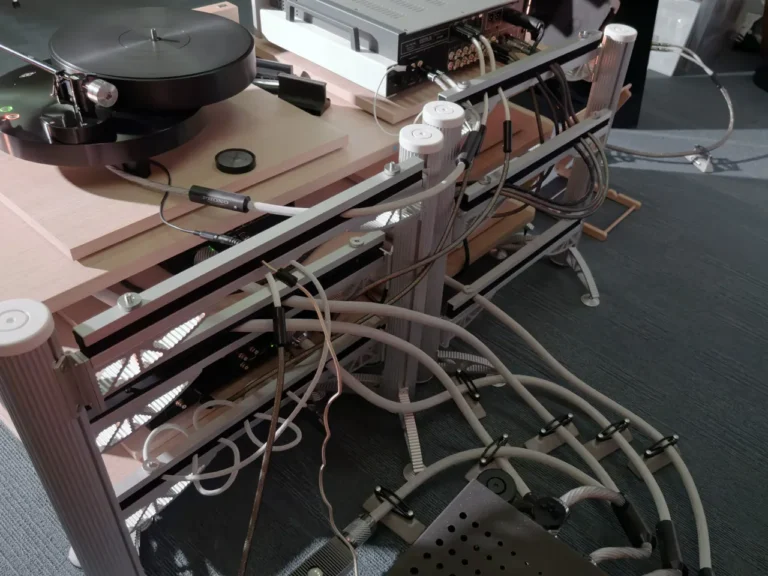

Should a Power Amplifier Plug Into the Wall or a Power Conditioner?

A substantial power amplifier and a substantial conditioner can share the same rack, both beautifully made and backed by serious engineering.
Neither price, weight nor audiophile reputation should choose the outlet. Electrical requirements come first. If the amplifier maker requires a wall receptacle, or the conditioner cannot support that amplifier on the particular outlet being used, the amplifier belongs at the wall.
Two familiar slogans obscure that decision. “Straight to the wall” is often presented as the purist answer, while conditioned power is cast as the sophisticated one. Yet neither category wins until the exact pairing is known. A conditioner may offer valuable protection but still be unsuitable for a particular amplifier’s current demands. Another may provide dedicated amplifier outlets and publish enough capacity to use them confidently.
Our order is electrical suitability first, listening second. Music can reveal a preference; it cannot establish an outlet rating, grounding integrity or manufacturer support. Start with a connection that both products explicitly support and that preserves the required current path and safety conditions. Then compare what you hear. Once that foundation is secure, the final equipment lead can do its proper work of refining the system.

What Comes First Before You Compare Wall and Conditioner?
Before a wall-versus-conditioner comparison, the amplifier power instructions carry more authority than any inherited rule about either category. The component maker sets the first default for connection, regional voltage, grounding and any warning about intermediate distribution. Those instructions address the demands and intended installation of the model you actually own.
Rotel leaves little room for interpretation with the RB-1582MKII. Because the amplifier can draw considerable current, its manual directs the owner to plug it into a wall outlet. That settles the decision for this model, not for every amplifier or every power conditioner.
Bryston’s guidance for the 9B3 shows why the category alone is not enough. It distinguishes conditioner topologies that may impede current to a large amplifier from other documented approaches intended to support current delivery. Different conditioners can present very different current paths.
When the amplifier manual requires a direct wall connection, stop unless its manufacturer gives different guidance for the exact arrangement. If an intermediary is permitted, the conditioner must identify both an appropriate outlet and sufficient capacity for the amplifier. Both components must clearly support the departure from the default. Silence from either one is a poor basis for experimenting with a demanding load.
Only then does listening become useful. Keep the amplifier, programme material, level and cable routing stable, and listen for differences that repeat and matter in your system. Compare only two electrically appropriate connections. Music can reveal preference; published electrical requirements establish suitability. If just one connection is supported, there is nothing useful to compare.
When Is a Direct Wall Connection the Stronger Choice?
A direct wall connection is stronger whenever the amplifier maker calls for it, or the device in between cannot demonstrate suitability for both the amplifier and the total connected load. The question is current delivery, not electrical-purity romance. The simpler connection wins when the intermediary has not earned the job.
Combined load matters because an amplifier rarely shares a distributor with nothing else. In the cited installation, Rotel permits a heavy-duty multi-tap only when both the strip and wall outlet are rated for the current demanded by the amplifier and every other connected component. The entire path must carry the entire attached load. One undocumented link is enough to reject the shared arrangement.
Amplifier output power, a transient headline and a continuous electrical rating answer different questions. Use the figures and permissions published for the component and distribution device in the market version you own. If they do not align, the wall avoids inserting an unqualified device between the branch circuit and the amplifier; that is preferable to an improvised calculation.
Protection and current suitability are separate virtues. A direct wall connection may leave the amplifier without conditioner functions such as surge handling or shutdown during abnormal voltage, which can matter greatly in a particular installation. But valuable protection cannot make an unsuitable outlet suitable. A conditioner should replace the wall as the default only when both protection and current suitability have satisfactory answers.
When Can a Conditioner Be the Right Choice for an Amplifier?
When the amplifier permits conditioned power, a high-current conditioner outlet can be the right destination—but only if the conditioner assigns that exact outlet to amplifier-class loads. The regional model, continuous capacity, bank assignment and total connected load all have to agree, because the individual outlet matters more than the chassis label. “High current” on the fascia starts the case; it does not complete it.
The AudioQuest Niagara 3000 makes this division easy to see. Its current product information separates five source outlets from two high-current outlets intended for power amplifiers, powered speakers or subwoofers. An amplifier placed on a source outlet would disregard the design’s own division of duties, even though all the receptacles share one case. Outlet banks are not interchangeable parking spaces.
Continuous capacity is a separate check. For the 120-volt Niagara 3000, AudioQuest publishes 15 amperes as the unit-level maximum RMS current and separately identifies its two High-Current outlets for amplifiers, powered speakers or subwoofers. That 15 A rating applies to the whole unit, not to each outlet or bank. It also applies only to that model and voltage version, so it cannot be carried over to another conditioner or market. AudioQuest discusses transient-current capability separately; a peak claim cannot replace the continuous combined-load check for everything connected to the Niagara.
Here is the positive case for using a conditioner: its amplifier outlet is supported, its capacity suits the installation, and its protection functions answer a real local concern. Under those conditions, an appropriate current path and useful protection can coexist. The amplifier’s own guidance must still permit the arrangement.
Revisit that judgment when the system changes. A second amplifier, powered subwoofers or other substantial loads alter the combined demand even if the original arrangement was sound. Moving between regions can change the relevant voltage version and plug configuration as well. Major equipment or market changes call for a fresh reading of both manufacturers’ instructions.
When Is the House Circuit the Real Constraint?
A dedicated amplifier circuit is worth discussing when the existing electrical service shows that it is the constraint, not as a ritual upgrade for every serious system. Mark Levinson’s guidance for the No. 5805 and No. 5802 notes that demanding loudspeakers or multiple power amplifiers can bring the service into play. The installation must supply the reason for a dedicated circuit.
At that point, the answer lies beyond accessories. A dedicated AC circuit becomes a professional consideration, justified by an identified electrical need.
Before considering any accessory, configure the amplifier for the local line voltage, use the correct regional cord and keep the protective grounding intact. A plug adapter or lifted safety ground is not a clever answer to a mismatch. If the wall receptacle, conditioner plug or amplifier inlet does not match the intended regional configuration, compatibility becomes a safety condition.
Multiple circuits require particular care because signal cables still join the audio components. For the situation covered in its manual, Mark Levinson directs the owner to a licensed electrician so the system retains a common, low-impedance ground reference. Panel work, receptacle changes, grounding relationships and new circuit installation all sit beyond the rack. Building wiring belongs to a qualified professional.
Stop swapping accessories if you encounter heating, a loose or damaged receptacle, nuisance breaker trips, questionable voltage, hum associated with multiple circuits or uncertainty about grounding. Those symptoms do not prove that a cable or conditioner is at fault. They show that the electrical foundation needs competent assessment. Wall-versus-conditioner listening can wait until the foundation is sound.

Why Should You Choose the Outlet Before the Power Lead?
An amplifier power cable is the final interface between the chosen mains source and the component. It therefore enters the decision after the upstream connection is known; it cannot decide whether that source should be a wall receptacle or a conditioner. Changing the lead while the outlet remains in question mixes two variables and muddies the result. Choose the outlet first, then refine the interface that completes it.
Match the cable to both the selected mains source and the amplifier: regional plug, receptacle, amplifier inlet, protective grounding, electrical suitability, and a length that reaches without strain or an extension. Connector labels alone are not enough when ratings or market versions remain uncertain. The principle behind choosing the right cable category for each system connection applies exactly here: the cable must serve the connection in front of it.
That is where NESS Excellence enters the conversation. We offer EU and US AC/IEC versions, six configurations and selectable lengths from 1 to 5 metres in half-metre steps; an individually specified length is also available. The cable choice can follow the real receptacle, inlet, region and distance.
We or your Audiomica dealer can confirm the exact connector and electrical suitability for the named amplifier and market. Confirmation keeps specification separate from speculation.
With the mains source correct and stable, the comparison becomes cleaner. The premium lead is no longer expected to compensate for an unsupported conditioner connection, and the conditioner is not credited with qualities that belong to cable construction. Now the equipment lead can be judged as a deliberate electrical and mechanical choice, rather than an accessory added at random.
Why Is NESS Excellence Worth Considering for a Serious Amplifier?
The NESS Excellence power cable is worth considering once the amplifier has an electrically suitable source and the cable specification is confirmed. It particularly suits the listener who wants the final mains interface to show the same constructional intent as the amplifier it serves. Look beyond the plugs at either end: conductor, dielectric, screening, contacts and mechanical execution form one designed assembly. That complete assembly is the source of its premium interest.
The electrical construction is specific. NESS uses five 4.17 mm² conductors made from OCC 6N copper, FEP insulation and a copper-braid screen. We specify AML-RC10-Rh plugs whose contacts use red copper beneath a non-magnetic rhodium layer. These details work together from conductor to termination; no lone exotic ingredient has to explain the whole cable.
The mechanical construction receives equal attention. NESS uses an aluminium housing, POM-C AP50 couplers mounted with a non-magnetic screw, and hand-made assembly. A substantial power cable has to be handled, routed and supported behind heavy equipment, where it will be connected, bent and touched repeatedly. Craft has a physical role at each of those points, without making any one construction detail a promise of a sonic result.
We intend the copper braid and aluminium housing to protect against external electromagnetic interference, while the POM-C AP50 couplers are intended to protect against static electrical changes. Those aims bring the installation into focus: proximity to switching supplies, routers and crowded cable runs, stability at the inlet, and enough length for calm routing. The design details point back to physical conditions you can inspect.
Standard and Luxury are distinct constructions. We offer the optional TFCT Double configuration specifically for the Luxury version, describing its power-cable filter as designed to minimise or eliminate external interference and support proper device operation. The filter belongs to the selected cable configuration; it does not replace the upstream choice between wall and conditioner.
If this construction matches your system priorities, explore the available NESS Excellence power cable configurations and ask us or your Audiomica dealer to confirm the regional plug, equipment inlet, length and electrical suitability before purchase. Then audition it without changing the established mains connection. Ask familiar music for a repeatable reason to prefer it, while leaving the outcome open and keeping the documented construction in view.
The outlet and cable answer different questions, even though they meet at the amplifier. The outlet protects the integrity of the current path and installation; the cable refines the final interface once that connection is known. Taking them in that order avoids both folklore and token accessory buying. Choose the electrically supported connection, then give the cable the same deliberation.