

Sources: PS Audio PWT; Dr. Feickert Blackbird/DFA 1o5/Zu DL-103; Phasure XX-PC and NOS1 DAC
Streaming sources: XXHighEnd; iTunes; Devialet AIR; La Rosita Beta
Preamp/integrated/power: Audio Note Meishu with WE 300B (or AVVT, JJ, KR Audio 300B output tubes); dual Devialet D-Premier; Hypex Ncore 1200 based monoblocks; Trafomatic Kaivalya; Trafomatic Reference One; Trafomatic Reference Phono One; Music First Passive Magnetic;
Speakers: Avantgarde Acoustic Duo Omega; Arcadian Audio Pnoe; Podium Sound One;
Cables: complete loom of ASI LiveLine cables; full loom of Crystal Cable cables; Full loom of Nanotec Golden Strada; Audiomica Pearl Consequence ic;
Power line conditioning: PS Audio Powerplant Premier; PS Audio Humbuster III; IsoTek Evo 3 Syncro
Equipment racks: ASI amplifier and TT shelf
Sundry accessories: Furutech DeMag; ClearAudio Double Matrix; Nanotec Nespa #1; Franc Audio Ceramic Disc Classic; Shakti Stones; Manley Skipjack, Akiko Audio sticks
Online Music purveyors: qobuz.com, bandcamp.com, amazon.co.uk
Room treatment: Acoustic System International resonators, sugar cubes, diffusers
Room size: ca. 14.50 x 7.50m with a ceiling height of 3.50m, brick walls, wooden flooring upstairs, ca 7 x 5m with a ceiling height of 3.50m, brick walls and concrete floor downstairs.
Price of review item: Allbit Consequence silver plug 2 meter €2’270, 3 meter €2’700, 4 meter €3’100. Add €150 for TFCT filter and €220 for Double TFCT filter.
Audiomica Laboratory of Poland’s Gorlice township are a well-established cable manufacturer and household name in their country and for good reason. Plowing the audio fields where probably the most of all hifi controversy resides, the men and women of Audiomica are not afraid of kicking sacred cows. Take active filtration in cables. This raises the blood pressure of most devout audiophiles. Thou shallst not tamper with the signal is their cherished belief. But what if that very tampering helps to get far better results? Isn’t every component in an audio system a form of filter? Whenever we introduce a new cable, the sound changes. Sometimes we praise the workings of that cable as being the ultimate revelation. Sometimes we simply dislike the results.
The simple fact is that we start with a signal which is what it is – the result of musicians playing, recording engineers recording, mixing engineers mixing, producers adding their flavour and the mastering engineer finalizing the product. That product is what we must deal with. Alas everything which now follows in the process called playback becomes a form of filtering.
If not we’d have attained to the mythical straight wire with gain, the squaring of the circle for everything. But that’s plainly impossible as decades of audio development prove painfully. No medium has been best. Shellac, vinyl, tape, optical disc or magnetic storage… the optimum has not been found.
On the playback side there are tubes. Transistors. Ribbons. AMTs. Electrostats. Dynamics. Passive preamps. Active preamps. PCM or DSD processing. Whatever you could possibly come up with, none of it has no effect. That’s simply the hifi reality all of us face.
Check out more Consequence Series

Filtering now becomes a legitimate playback option to optimize the workings of the various components in our playback chains and help us reproduce the musical signal as best as possible. In case of a power cable with built-in filter, the obvious mission is to filter out all the junk which modern living conditions dump into the power line. All we want from the AC power is a pure voltage at a stable fixed frequency, nothing more. But the junk riding atop that AC power as noise and shape distortion of pure sine waves originates not merely with external sources well outside our homes down the block. We contribute ourselves to the overall electro smog. Just take your actual hifi system. Many of its components run at high frequencies to radiate spurious signal picked up by neighbouring components. Having all of it so conveniently placed together doesn’t help matters either.
In their today extensive cable portfolio Audiomica use four different filtering methods. For power cords they use TFCT or two filters current tension. By applying this filter method to a well-shielded power cable, the result is an inline power conditioner. The filter itself is built on a PCB with capacitors and small chokes. Protective earth or ground is filtered by some of the capacitors whilst the parallel chokes augment impedance of the hot and return legs. By increasing the impedance the other capacitors on the hot and return work more effective. Besides the standard TFCT filter, there is also the TFCT Double. In this filter an additional filter stage runs a third capacitor and second choke. To accommodate these extra components, the PCB is enlarged, hence also its housing. That sits roughly 25cm from the silver-plated Schuko plug of the cable.
Say hello to the Allbit Consequence. Its 8 conductors of 12 AWG or 2mm have a cross section of 3.3mm2 built up of 75 individual OCC copper strands. A FEP jacket isolates each of the 8 conductors before the first shield is applied. Next come a PVC jacket followed by a braided copper screen before a white PET sheath finishes the cable. Indeed, the Allbit power cable is a shielded power cord. That’s another no-no for certain audiophile purists but based on what rationale?
Together the Allbit Consequence and TFCT Double filter form the top of this power cord offering currently available from Audiomica. We received the cable in their signature wooden box which is classy but not over the top. The packaging also underlined the flexibility of the cable which easily fits inside the 23 x 23cm box.
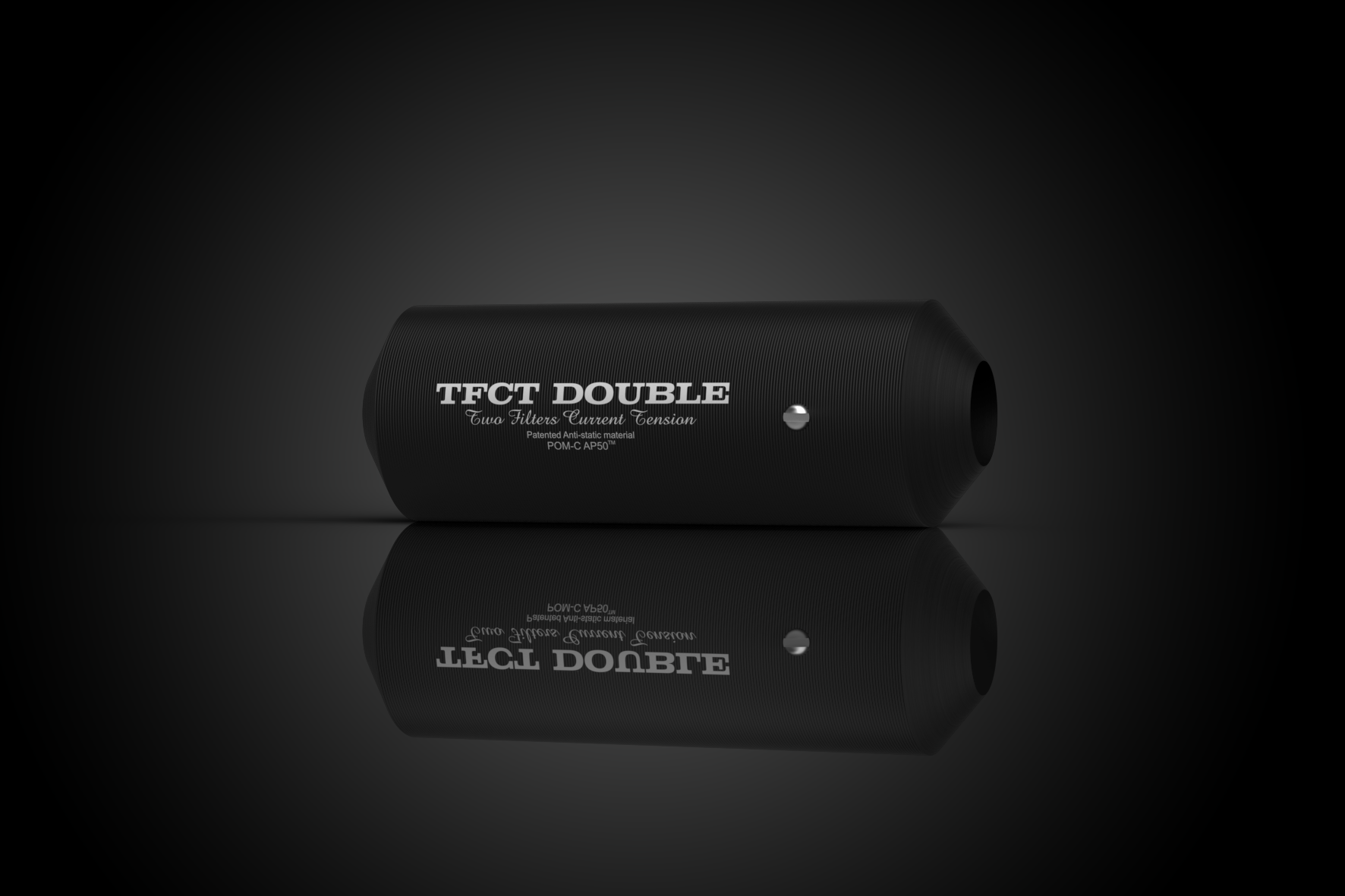
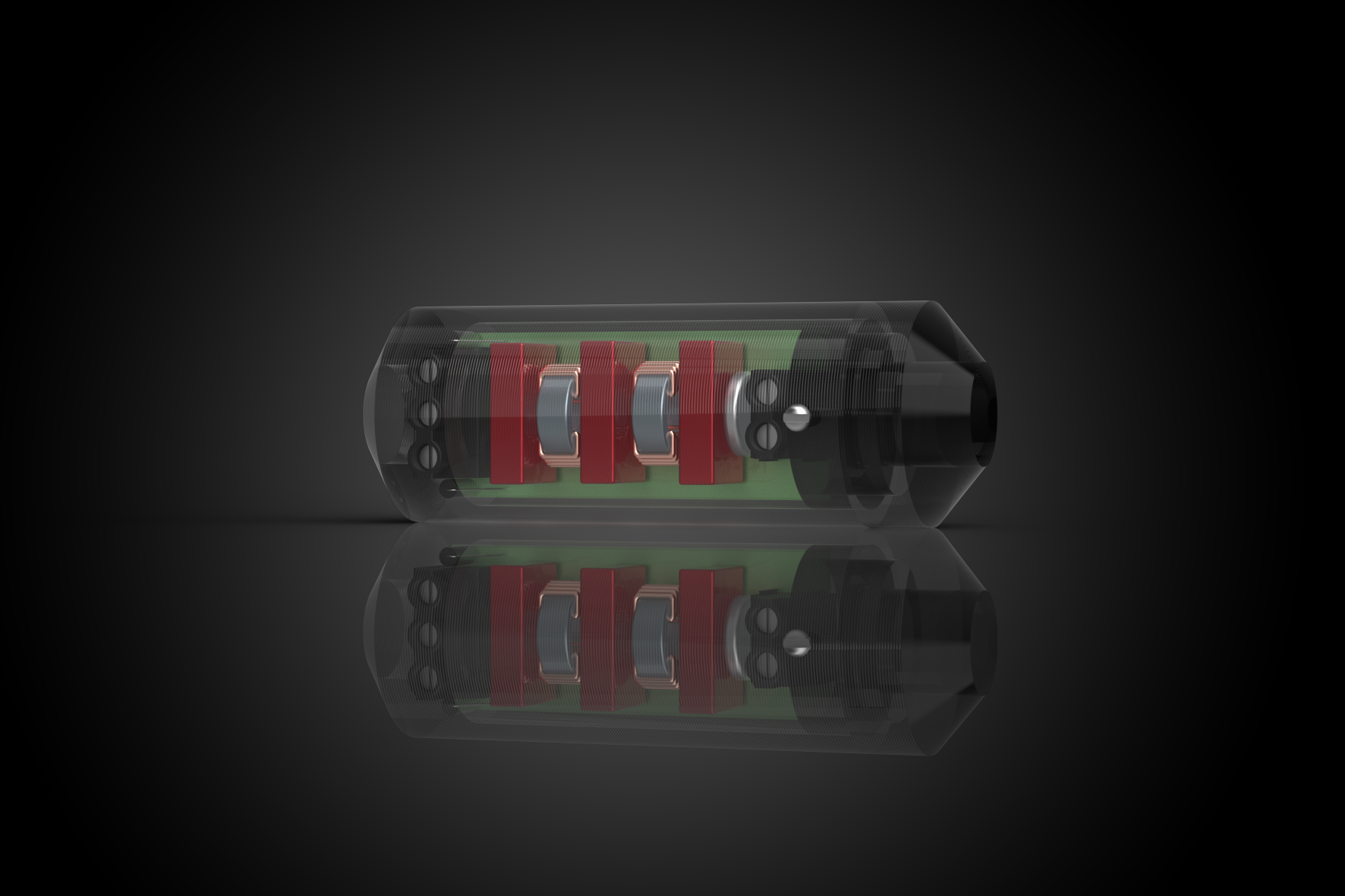
Before applying the cable in one of our systems, we took it to one of our worst wall outlets. For some strange reason one electrical grouping of two wall outlets transmits a radio station’s signal plus an off-the-charts amount of noise. These findings are quantified with our Blue Horizon Mains Noise Analyzer. From these bedeviled wall outlets the Analyzer’s display shows a maximum 999 noise pollution value and over its built-in speaker emits a screeching noise plus a religious radio station broadcasting Hail Maries and the works. We aren’t kidding. When the Audiomica Allbit Consequence TFCT Double inserted itself between this wall outlet and the Analyzer, the display dropped to 087 and the tiny speaker fell silent.
From a measurement perspective this Polish cable reduced noise by nearly 100%. This achievement was a personal record only matched by the PS Audio Powerplant Premier (not its successors P5 or P10) and Cammino Harmonizer power conditioning boxes. We suspect that the older PS Audio device used a step-up transformer to make it 240 volt compatible and thus applied galvanic separation. Anyway, no other power cord has matched the filtering potency of this Polish cable.
Time for musical duties. Over the years we’ve learnt that source components are prime candidates for power anomaly cures. Therefore we plugged the Allbit into the XXHighEnd PC and accompanying Phasure NOS1 DAC, making sure of correct power polarity [M&H live in Holland whose power-plug standard is the symmetrical two-prong Schuko which can be inserted two ways – Ed.]. Downstream a pair of Ncore 1200-based Hypex monos fed our 100dB Pnoe hornspeakers. Once the PC booted up awaiting our ‘play’ command, we raised the digital volume control higher and higher to asses the amount of noise from the speakers. When we reached -4dB there still was no sigh, hiss or hum coming from the speakers even with the ear almost touching the AER driver’s whizzer. Yes, we finally arrived at a super quiet high-efficiency system where all ground loops have been banished. Clearly the Allbit’s protective earth filtering feature did its magic very effectively.
With the volume clicked down to a sensible setting, it was play time. Should it suffice to say that the first listening session took a few hours? The transformation our system underwent came down to a super quiet background which enabled even the softest details to be rendered unobscured. The sense of a recording’s space was uncanny due to its sounds’ decay times being considerable longer than ever perceived before. Not only soft details now came to the fore above the undetectable noise floor. Transient separation was uncanny too.
Have you ever tried to count the rivets on a sizzle cymbal? If so inclined, you could do now. Instead of a single swooshing sound, there was an irregular combination of individual ts, ts, ts. Crash cymbal? Whack and over. In the lower frequency department things had changed as well. For a single-driver hornspeaker the Pnoe is not really bass shy but when we feel like it, we add the Zu Submission for the lowest octave of ambient, psytrance and fare where 20Hz is really present. With the introduction of the Allbit there was change here too. At first the low frequencies appeared to be somewhat leaner, less intense. But then the notion arose that the bass had actually intensified and was far more enveloping. The previously full and rotund bass had actually been the result of added noise like the quasi euphony certain tube amplifiers are admired for. Now the truth was out there.
Over at the other side of the room we run a second system which we configured to be a Feickert Blackbird/Zu DL103 turntable with a Devialet D-Premier tripling as MC phono stage, pre and power amp. Speakers were Podium Sound’s Model 1, a bi-aurally decorrelated panel radiator in combination with a separately powered WLM Duo stereo sub. Which component here should connect with the Allbit was an easy decision: the Devialet. Contrary to Devialet’s claims, the D-Premier is very sensitive to power cables. The right combination really will transform this all-in-one completely. The 50-cent generic cord keeps the Devialet on relatively neutral ground. With the Allbit as power transport, the French pizza box went through a severe metamorphosis.
The transparency and directness we like with its V5 firmware was still there but the sound had opened up as though a crowned eagle suddenly spread its wings showing off all its glory. Playing music with the Podium Sound panels is an acquired taste but especially with classical music mimics a very ‘live’ experience. When we swapped the panels for the Pnoe horns by rewiring the speaker cables and repeated the A/B with the power cords, the Devialet transformed once more to repeat the effect.
A final check included a full Trafomatic set of Reference One preamp and Kaivalya monos. Analog source was the Feickert Blackbird via the Reference Phone One or the analog output of the La Rosita Beta/iTunes streamer combo. The Allbit did chores on the source side in combination with a power distribution block. Again the sound changed for the better. Tube equipment has an intrinsically higher noise floor where there is always a little background noise audible close up to sensitive speakers. The Allbit again proved successful at lowering the perceived noise to a level only noticeable close to the drivers. In the sweet spot the soft noise was completely gone.
Using a different perhaps not fully audiophile-approved solution (which would be what, exactly) to help music lovers enjoy their music on a higher level, Audiomica have really hit upon something. Adding a comprehensive filter that includes protective earth filtering to a high-quality shielded power cord results in a true multi-purpose power cable. Used as a single component cord on a source raises that component’s sonic capabilities beyond expectation. Used as a feed into a high-quality power distribution block becomes the most economic proposition to enable a multitude of components to benefit from the cleanest power. Chapeau!
Condition of component received: Excellent.
Reusability of packing: No problem and for many purposes.
Website comments: In English and Polish. Not quite up to date at the time of writing.
Completeness of delivery: All we needed.
Pricing: Absolutely fair.
Human interactions: As kind as it gets.
Remarks: This power cable is marketed as being designed for the Audiomica Power Station but run solo or with another quality distribution block is highly recommended.
